
The Hokkaido Ken is in crisis. There are currently an estimated 5,000-7,000 dogs left in the world; it is likely that the true number is closer to the lower end of this estimate and in reality there may be even fewer. The breed population that exists worldwide today will no longer provide a viable and genetically diverse breeding population to be able to increase, or even sustain the current numbers. A very informative blog post by Claire, a fellow Kokkaido breeder at Kaiju Kennels in the United States, shows just how unsustainable the population is. This post was written in October of 2020, and since then, the breed population has continued to decline.
The catastrophic decline in population can be attributed to a variety of reasons; from lack of interest in the wider dog fancy; to poor genetic diversity; plus many other cultural reasons in Japan and across the world. Covid 19 didn’t help with the numbers, as the ban on international travel meant for 2+ years dogs were limited in their export abroad from Japan, and other countries. Some breeders in Japan have sought international help, assisting in the export of dogs to other worldwide breeders and enthusiasts, however it seems like we are fighting a losing battle. Whilst it is unlikely the breed will go extinct int he next 20 years, this steady decline will continue and the population of breeding dogs will become narrower and less diverse over the resulting generations, unless something is done. Outcrossing is a method frequently used with breeds in crisis, however any outcross project should not be undertaken without the acceptance and guidance of the country of origin. Currently, no outcrossing project has been permitted by the Hokkaido Ken Hozonkai – in fact it is widely accepted that the breed should rather go extinct than lose the essence of the breed by outcrossing – and it would be disrespectful for international breeders to undertake such a project on their own accord.
The Hokkaido Ken has deep cultural meaning to the island of Hokkaido, and Japan as a whole, with the breed being designated as a Living Natural Monument by the Japanese Government in 1937. The breed has been under this prestigious status – denoting their cultural significance – for nearly 100 years. Whilst we truly want this breed to thrive, and come back from the brink, we believe that it is also not our place to disrespect the history, and culture of the breed, and their native country, by outcrossing.
Even though the Hokkaido Ken has poor genetic diversity as a whole (whereby most individuals are genetically related to each other, even if ‘on paper’ they appear not to be), they still remain a fairly healthy and long-lived breed. It has been noted, however, that their fertility seems to drop after the dog reaches 4 years old, females may struggle to conceive or carry pregnancies to term, AI (artificial insemenation) is often unsuccessful, and sperm concentration and motility drops in males as they age. In general they produce very small litters, where 2-4 puppies in a litter is normal (though there have been a few cases of 6 puppies being born in a litter).
This blog post by Shigero Kato, of the Nihon Ken Forum posted in 2018, also shows the decline of not just the Hokkaido Ken, but the other medium Nihon Ken breeds too.
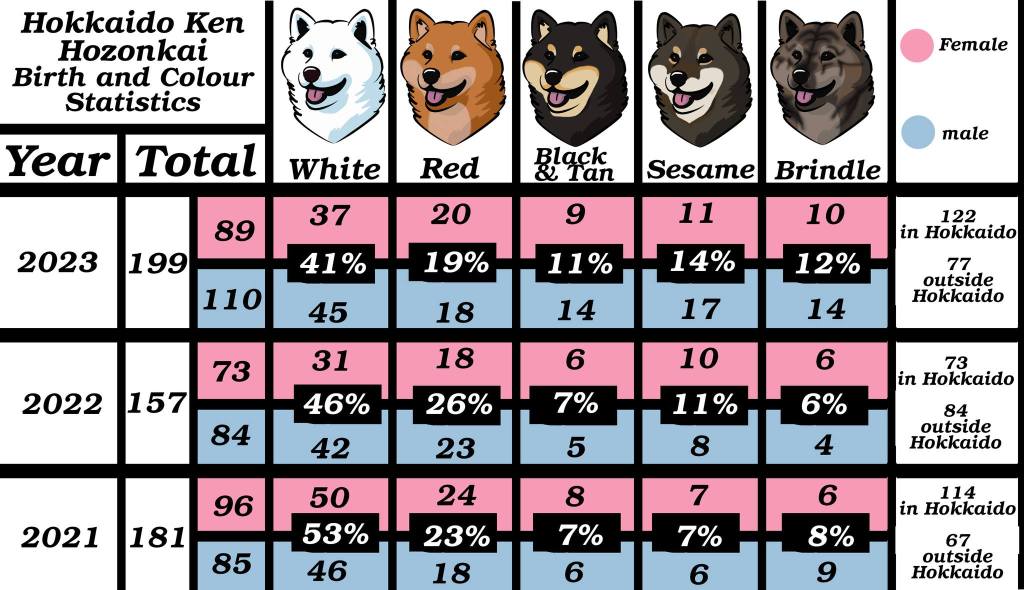
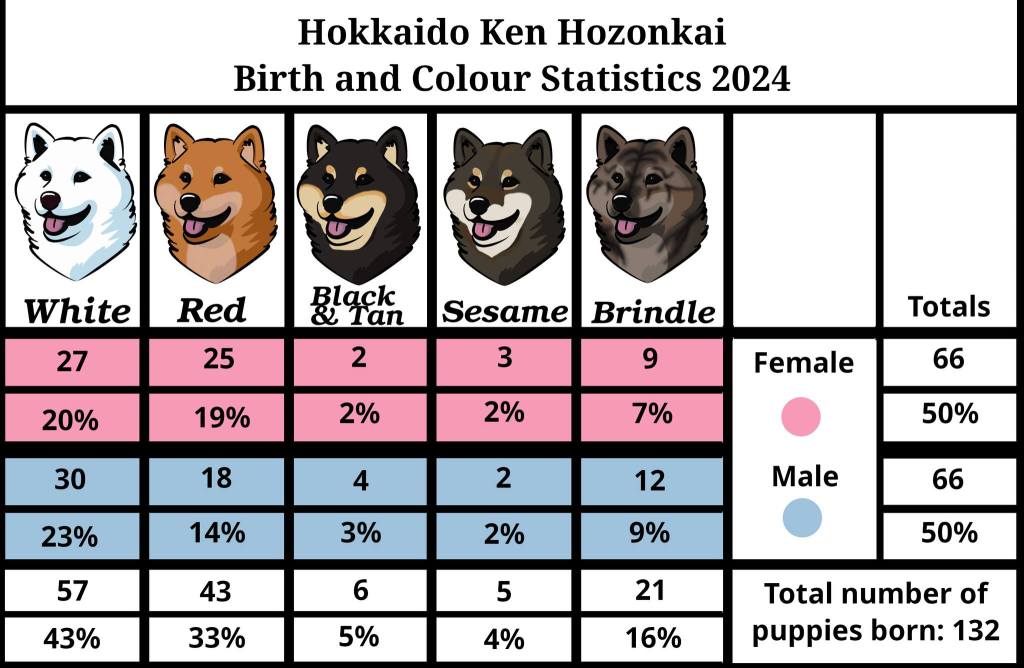
Below we have some infographics of the Hokkaido Ken numbers from 2021, to 2024, showing numbers born with statistics split by sex and colour, over the year. As you can see, less than 200 Hokkaido are born every year, with the number declining particularly in 2022 (this was due to Covid 19, where Japan was still in lockdown). There was a slight uptick in 2024, but this number is nowhere near enough to sustain a healthy population as most of these dogs will not go onto breed. Please note that these infographics do not include dogs born outside of Japan, they only include dogs born within Japan and registered with the Hokkaido Ken Hozonkai. However, the amount of dogs born across the rest of the world, we estimate to be around 10-50 per year (most likely on the lower end).
Okiyama-san , who is a well known breeder of Hokkaido Ken, in Hokkaido, cited many reasons for the breeds decline, including the following:
~ The larger worldwide economic downturn, forcing families into smaller living accommodation and with less disposable income to buy and take care of pets. Alongside a greater degree of uncertainty when it comes to securing a stable job.
~ The aging of many of the breeds protectors especially in Japan- the breeders and people who own kennels or keep multiple dogs. Many of those who have kept the breed for years are unable to find successors to continue breeding.
~ The Hokkaido is a strong dog who needs a strong owner, which means younger people to take up the mantle of the breed and its preservation, however, the younger generations are finding it more difficult to survive in the economic climate and live in smaller spaces not suitable for this kind of dog.
~ Global warming may be a contributing factor to the breed’s lack of popularity in Japan, where summers are extremely hot, the Hokkaido Ken is not so well adapted to the rising rapidly temperatures.
~ The laws of other countries changing and making the import/export of dogs much more difficult will inevitably be a contributing factor to the decline of the Hokkaido Ken outside of Japan, along with more red tape and paperwork for breeders.
This is a breed which we love, and ultimately, we want to share our lives with these dogs for as long as we can, but unfortunately, this may not be as long as hoped it to be. There are currently a handful of breeders around the world trying to increase their numbers, but unfortunately, it isn’t enough and without interest from people wanting to share their lives with these dogs, breeders cannot continue to have litters. There is currently no funding or official programmes being run anywhere in the world to help the Hokkaido Ken, and so the breed relies solely on its enthusiasts to raise awareness of their plight, educate and generally get them out into the world where they can be seen.
Hokkaido Ken birth and colour stats 2021-2023- Special thanks to Okiyama-san and the Hokkaido Ken Hozonkai for this data
Hokkaido Ken birth and colour stats 2024- Special thanks to Okiyama-san and the Hokkaido Ken Hozonkai for this data
 The British Association of Hokkaido Ken - BAHK